IAS Artist-in-Residence explores political agency of the sea through sound
18 June 2025
Listening as political practice
Through his artistic practice and collaborative research, ‘t Hart challenged the traditional, human-centered narratives that dominate environmental discourse. His residency was grounded in the mission of the Embassy of the North Sea: to treat the sea, and more generally nature, not as a silent resource, but as a political subject.
The idea of "giving a voice to nature" often implies that nature is passive or voiceless. ’t Hart resists this framing. He explained: “nature is not silent, it’s speaking, we just need to learn how to listen.” At IAS, he deepened this inquiry, drawing on sound art, law, philosophy, and ecology to develop interdisciplinary approaches to more inclusive forms of representation.
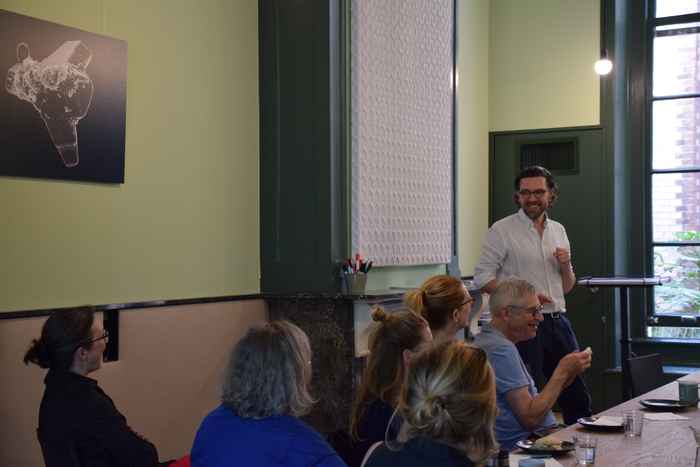
The kickoff event for his residency, introduced the methods and practices of the Embassy of the North Sea. The Embassy continuously seeks ways to amplify non-human voices, whether they originate from reefs, tides, or sandbanks, into the realms of policy and law.
Rethinking legal and ecological frameworks
During the event, ’t Hart shared examples of how different reef conditions produce distinct sounds, an acoustic expression of wellbeing or distress. These observations raise vital questions: can we translate such signals into political or legal claims?
The event sparked lively discussions around nature’s role in democracy, conflicting legal frameworks around ecological protection, and the limits of human perception in policymaking. Participants explored whether the sea could ever be directly represented in court, and how law might evolve to accommodate ecological voices.
Harpo ’t Hart’s residency at IAS opened a space for these urgent and imaginative conversations, inviting scientists, artists, policymakers, and the public to listen differently, and to reconsider what it means to represent the natural world.