Tipping points in mental illness revealed
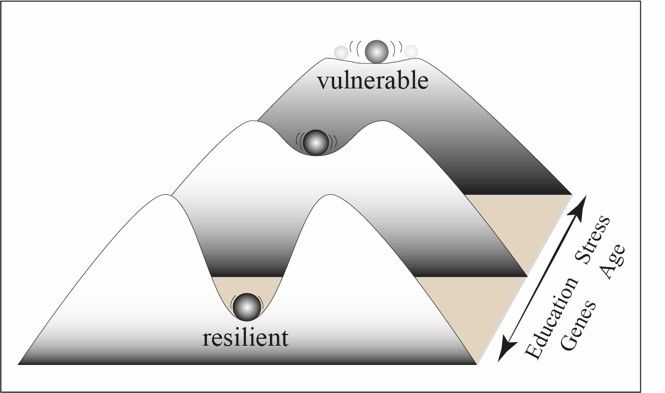
Scientists have found that tipping points known from climate and ecosystems also appear in psychiatric disorders. This allows novel ways to predict the onset of disorders, but also helps understanding the effects of lifestyle on resilience, and the observation that brief interventions may sometimes tip patients out of illness permanently. The work is published this week as two articles in the prestigious journal JAMA Psychiatry.
Psychiatric disorders can keep coming back with symptoms changing over a lifetime. This makes them fundamentally different from other illnesses. Experts agree that unlike physical problems such as bone fractures, pneumonia or cancer, mental disorders often cannot be unequivocally diagnosed. Also, there are no straightforward one-size-fits-all treatments. Despite this recognition, there has been no alternative to the classical disease framework. Now an international group of recognized psychiatrists and complexity scientists shows that the fundamental principles that rule stability of lakes or the climate system also apply to the human mind.
“This makes a lot of the pieces fall together” says co-author Kenneth Kendler, psychiatrist known for his groundbreaking work on the way in which genes and other factors interact to cause schizophrenia and other disorders are. The novel insights also point to new ways forward. “It turns out that the mathematical theory that helped us find new early warning signals for the loss of resilience in lakes or forests also applies to the human mind.” Says complexity scientist Marten Scheffer. “Such early warning signals may be picked up from smartwatches and smartphones and then used to guide interventions that bolster resilience when needed.”
Not only the measurements are improving. Over the past years it has become clear that the spectrum of helpful interventions is much broader than we thought. Evidence is piling up that exercise and the choice of food can have marked effects. “It also helps to give patients the mental tools to stay well.” Says Claudi Bockting, clinical psychologist at AmsterdamUMC at the University of Amsterdam. “We now have evidence that a brief psychological cognitive intervention substantially reduces the risk to sink into a depressive relapse up to 20-Year.”
The new way of viewing mental illness supports the idea that instead of silver bullet cures, most patients may benefit more from a holistic approach. “That used to sound a bit vague to many doctors in the past, but now we realize that for managing the mind as a complex system, we might as well borrow some solid insights from other fields of science that study complexity.” Says co-author Barnaby Nelson, Psychiatrist at the Orygen institute in Australia specialized in mental health of young people.
Marten Scheffer recalls how the vision emerged from an unusual cooperation between scientists from different fields. “In one of the workshops, ecologists explained how lakes are managed to be clear instead of murky. The approach was to work on resilience by controlling factors such as incoming pollution, and when needed apply a brief intervention to flip a turbid lake to the clear state. For the psychiatrists and psychologists, the parallel to what they saw in their patients was hard to miss. We went on the same day to analyze the data from a large cohort of patients and were struck to find the tell-tale signs of complex systems with tipping points in humans. For ecosystems and the climate this is well accepted hard science by now. For psychiatry it is new.”
Full scientific articles
- A Dynamical Systems View of Psychiatric Disorders, part I The Theory
- A Dynamical Systems View of Psychiatric Disorders, part II Practical Implications
Both published in JAMA Psychiatry. Online version appearing April 3rd 2024.
For interviews and further information, please contact:
Netherlands
- Marten Scheffer (complexity theory, ecology): Marten.Scheffer@wur.nl
- Claudi Bockting (clinical psychology): c.l.bockting@amsterdamumc.nl,
USA
- Kenneth Kendler (psychiatry): kenneth.kendler@vcuhealth.org,
Australia
- Barnaby Nelson (psychiatry): barnaby.nelson@orygen.org.au