IAS Festival
In May 2026, the UvA Institute for Advanced Study celebrates its 10th anniversary with the IAS Festival: a week during which we open our doors to the public, and reflect on a decade of interdisciplinary research, while looking ahead to the questions of tomorrow.

From 18 to 21 May 2026, we celebrate ten years of boundary-crossing research and look ahead to the challenges of the future. Join us for a week of celebration, reflection, and forward-looking dialogue through a series of Future Challenges sessions. Explore urgent questions at the intersection of science, society, and the arts, brought to life by leading thinkers from across disciplines. Expect surprising perspectives, inspiring conversations, and ideas that spark new ways of thinking. Celebrate the past with us by imagining the future.
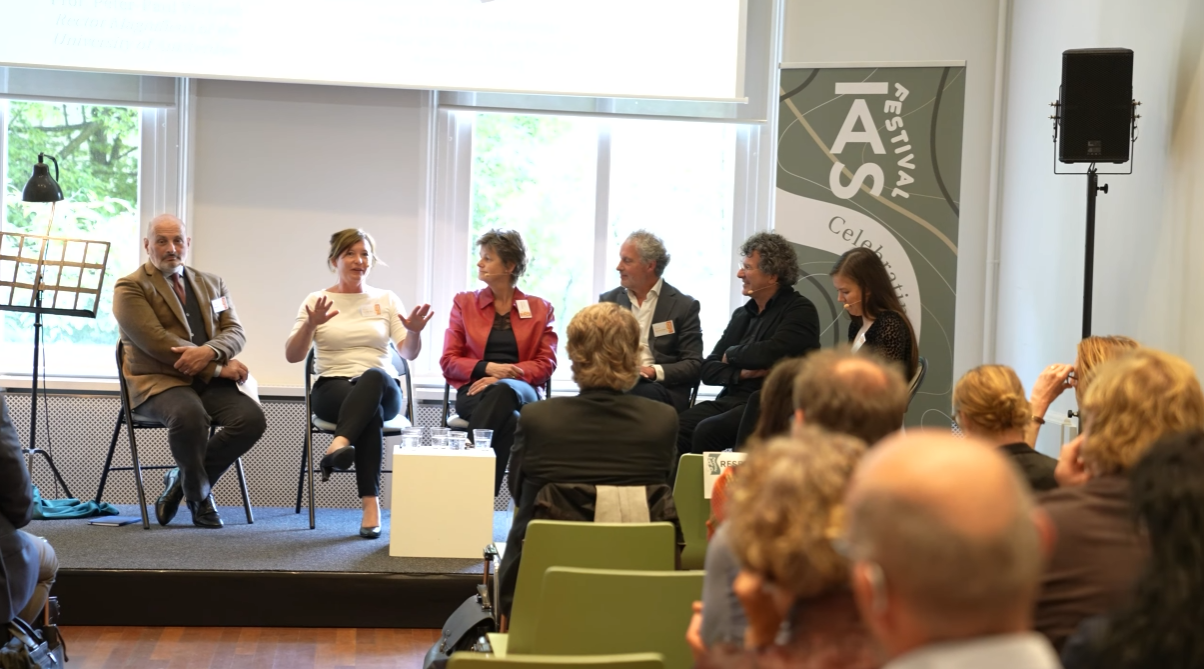
Crisis, from climate and AI risks to pandemics, require informed policies and well-informed citizens. How can society grasp how science creates knowledge, handles uncertainty, and guides action through clear methods?
Building A Shared Vision on Future Digital Infrastructures
In this collaborative workshop, the AI, Media and Democracy Lab aims to develop a shared IAS vision for digital sovereignty and to explore alternatives to our current digital infrastructures.
Technocracy Reading Group
The Technocracy Reading Group reads policy documents with a focus on form: graphic design, images, maps, style of writing. Reading these as text as a genre can be very revealing.
Beyond the Numbers: Rethinking How We Measure What Matters
We measure everything: From education outcomes, to carbon footprint, to sleep quality. Are these measurements truly meaningful, or do they simply generate data without insight, that may even be harmful?
Pathways towards an otherwise science: Mapping priorities and inspiring alternatives
This session invites participants to rethink how science could otherwise be and explore promising scientific practices together.
Overcoming Anthropocentrism?
This workshop addresses a central conceptual challenge in contemporary environmental thought: the persistence of anthropocentric assumptions in ethical, political, and technological imaginaries.
S.O.S. Mental Health: Toward Thriving Cities for Future Generations (morning session)
Mental health is under pressure. This Centre for Urban Mental Health symposium explores what influences the development of mentally healthy inhabitants and how interventions (AI and in person) may help.
Technocracy Reading Group
The Technocracy Reading Group reads policy documents with a focus on form: graphic design, images, maps, style of writing. Reading these as text as a genre can be very revealing.
POLDER: Unravelling complexity
In this session, POLDER explores how we can consolidate insights from Complexity Science and prioritise which methods and tools to improve to get more actionable information into decisions.
Network Science for the Society of the Future
Imagining 2036: how can network science shape a better society-and what will this demand from scholars, policymakers, and research infrastructure?
Tipping lakes, humans, and societies: the challenge of linking theory to data
In this session we will discuss the successes, promises and challenges of applying tipping theory to nature, humans, and society.
How useful is the complex-system approach in the study of humans?
How useful is the complex-systems approach outside the natural sciences? Does it also apply when studying humans, social systems, or even whole societies?
Technocracy Reading Group
The Technocracy Reading Group reads policy documents with a focus on form: graphic design, images, maps, style of writing. Reading these as text as a genre can be very revealing.
Emergence beyond boundaries and disciplines
In this session, the Dutch Institute for Emergent Phenomena (DIEP) addresses problems in complex systems across scales and disciplines with both local and national programmes that involve science, society and the arts.
Where Art meets Science: at the Scientific Institute as an Artist-in-Residence
Exploring how artists and researchers intersect, this session revisits past IAS collaborations to reveal what makes them thrive, sharing inspiring examples from the past and imagining new creative possibilities ahead.

Pain Imagined, Embodied, Told: A Polyphonic Encounter Between Art, Science and Care
Talking about pain is complex, as it is invisible and personal. Together with artists, researchers and clinicians, we explore how the arts can facilitate a more multi-voiced conversation about pain within healthcare.
Science & Cocktails: Predicting human life
Science & Cocktails pairs public science talks with live music and cocktails. In this session, Sune Lehmann explores human behaviour, raising questions about prediction, privacy, and what it means to be human.
Emergence: searching for laws of human behavior
In this event, the Dutch Institute for Emergent Phenomena (DIEP) introduces itself as a broad interdisciplinary research hub addressing problems in complex systems across scales and disciplines.
S.O.S. Mental Health: Toward Thriving Cities for Future Generations (afternoon session)
Mental health is under pressure. This Centre for Urban Mental Health symposium explores what influences the development of mentally healthy inhabitants and how interventions (AI and in person) may help.
The Future of Digital Research Infrastructure
Explore the future of digital research infrastructure in this panel discussion on how our tools shape our understanding of both the present and our futures.
Energy Transition through the Lens of Sustainable Development Goals
Explore how ENLENS and the Future of Energy seminar advance a just and sustainable energy transition, highlighting key results, cross-faculty insights, and progress toward the 17 SDGs.
