Truth, Water, and Memory: Landscape painting for beginners
Artistic Research presentation by Joe Davis and Bonnie van Vugt
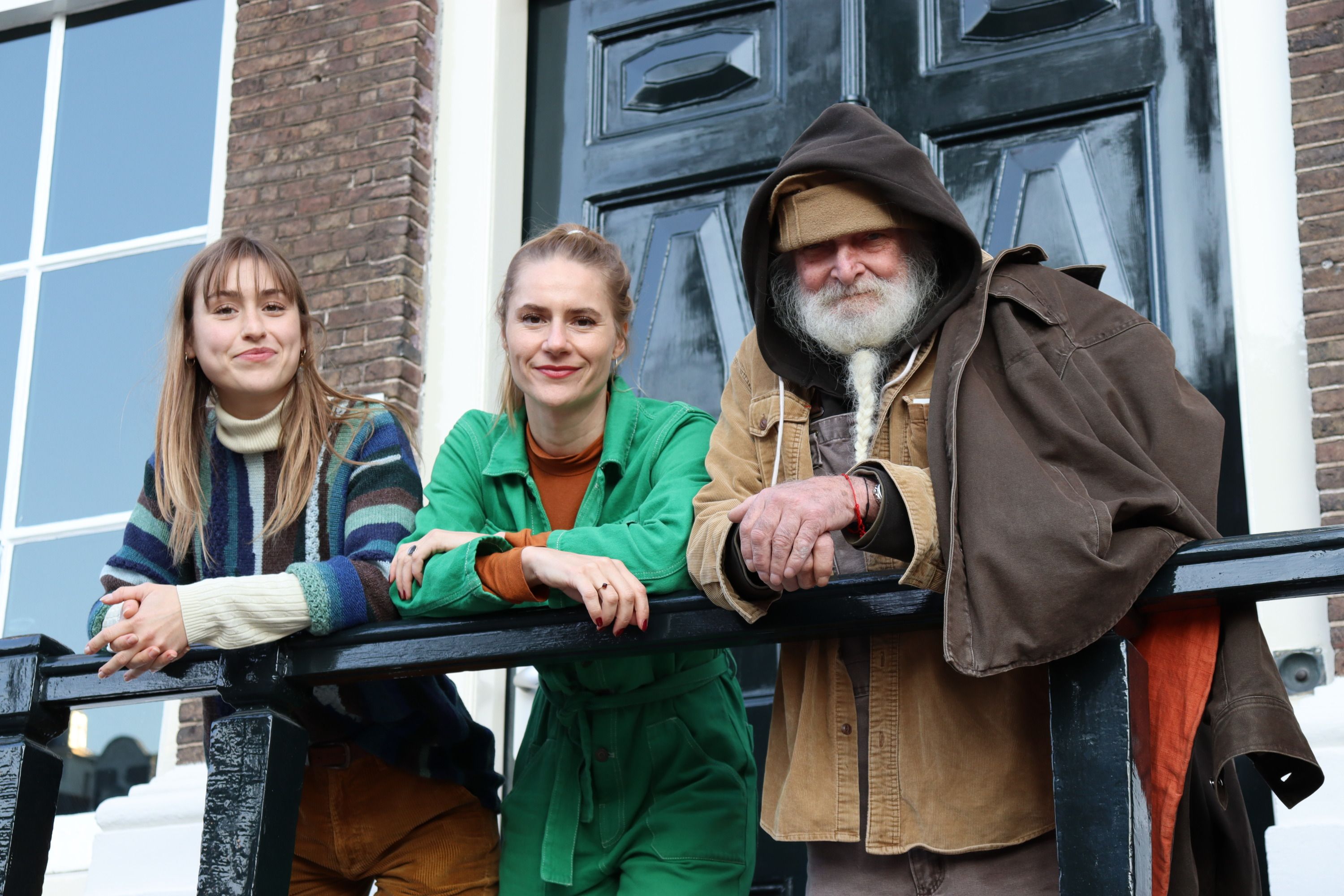
On the 14th of November BioArtist Joe Davis (MIT and George Church Lab at Harvard) visited the Institute for Advanced Study together with artistic researcher Bonnie van Vugt (UvA) to present their new project. Davis has been working on numerous ArtScience projects using synthetic and molecular biology and bioinformatics, using media including centrifuges, radios, prosthetics, magnetic fields, and genetic material. Together with van Vugt, who has a background in art and philosophy, they presented their new project on encoding bulk materials such as water, perfume and eventually landscapes.
Mapping a landscape
Inspired by Jorge Luis Borges’ short story ‘On Exactitude in Science’, about an imagined empire in which science has become so exact that only a map of the same scale as the empire itself will fulfill, the two are planning to make a map of a landscape that coincides with the landscape itself. Exactitude in Science hinted at scientists that believed they could produce a perfect map of the world, as the only map that would ever be perfect is a precise reproduction of its territory: a paradox. “Now it seems that a map of the world that coincides with the world itself might turn out to be possible, by using nonlinear encoding techniques,” say Davis and van Vugt.
Potential of DNA
In the past, Davis has worked together with scientists exploring the storage potential of DNA, by encoding microbes with 3D images. In 1986, he was the first one to demonstrate that information could be stored in genes by mapping ones and zeros of information onto sequences of the four nucleic acids of DNA. But now the artists are looking at other ways to write their vision into the world.
Bonnie van Vugt: “An unspoken aspiration of information-keeping in DNA is the notion of a greater biological archive, one in which the whole terrestrial biome becomes an incontrovertible, perpetual record of human culture and civilization. But there are some problems with this, due to the laws and ethical considerations around the release of recombinant organisms into the environment.” That is when they got the idea to look for other materials. They figured out that ordinary drinking water can hold information by precisely varying amounts of their respective component substances. Not only water but bulk materials like sand and clay, and even mixtures of scent are made up of different substances and are thus capable of holding information. According to the artists, this means that the soil of our earth can be encoded to hold information and become an archive for human knowledge.
Joe Davis: “Initially, we thought about this as an accessory rather than a replacement for DNA information-keeping, but if we can encode chemical compounds by atomic numbers, then we may actually be able to rival information density of DNA.”
‘Truth’ in water
In a proof-of-concept of their non-linear encoding technique and precursor to their 1:1 scale map, Davis and van Vugt showed during their presentation a small batch of water that they encoded with the word ‘TRUTH’. Together with chemist Thorsten Schulz and engineer Thomas Kaiser, they encoded the word ‘TRUTH’ into water by expressing ASCII as a solution of minerals that appear in drinking water. Since the ASCII numbers are binary and any number base can be readily converted to any other number base, there are also decimal equivalents for ASCII numbers that represent characters in the word ‘TRUTH’. By adding five different water soluble minerals to ultra-pure water, they were able to let the presence of their component elements in the solution coincide with quantities that exactly correspond with ASCII code for alphabetical letters in ‘TRUTH’. They made use of the incremental molecular weight of the encoded minerals so that the data could be reconfigured into the correct linear order.
Writing in a landscape
Van Vugt: “Since we can encode water now, we could also write in our landscape…” The artists are planning to do this by dispersing the water via air, by glider plane. They have recruited a glider pilot in Eastern-Massachusetts, where the artists have been practicing flying as well as collecting soil samples from the airfield in order to research their mineral components. They created a digital map of the airfield that can then be encoded in water using seven minerals, so in theory we could now have a map of the world that coincides with the world itself without ‘covering the world.’ But there are a lot of things that still need to be explored. Harvard professor in genetics George Church suggested serial liquid dispersals with several different minerals to see which minerals would be taken up by plants, so the artists are currently doing research on the mineral components of the soil and mineral absorption in plants in order to encode the water with the map.
New kind of library
The artists explored the possibilities of encoding different materials and with that invited the audience to think about a new kind of archive for human knowledge. They also pointed out that there is layers of meaning in everything, and that the sense of wonder in creating and understanding meaning is perhaps the most defining aspect of human nature. Davis: “Codes are systems of signals, symbols, textures, colors, shapes, and forms coupled with procedures for meaningfully combining them. Information science, on the other hand, has become the study of structures intentionally removed from meaning and purpose. Nothing is just zero or one, black or white.” With this ArtScience project, the artists imagine a new kind of library where ‘TRUTH’ is the first word saved.