Esmee Geerken on building to enact the environment
Esmee Geerken has been an ArtScience Fellow since May 2021 at the Institute for Advanced Study. During her fellowship she has explored building from a geological, chemical, biological and sociological perspective, in collaboration with IAS researchers, Waag and the Self-Organizing Matter group (AMOLF). She thereby playfully questions our perception of the obvious – the curvature of the Earth, and the peculiar – and how microscopic organisms build their shells.
Candy store
The ArtScience Fellow has a PhD in Earth Sciences and studied at the Gerrit Rietveld Academie: “It feels as if I walked around in a candy store during my PhD and during my Earth Sciences studies, where I got to taste the different types of subjects that intrigue me: single-celled marine creatures called foraminifera, the climate system, ecology, and soil and sea floor sediments - to name a few. My time at IAS also feels as being in this candy store, and in addition, I now am in position where I can use the all the topics I came across as resources that can be woven into my artwork.”
Foraminifera
Geerken is particularly intrigued by theories about the origin of life, and the question of how complex patterns arise from chaos, topics studies by many IAS researchers as well. How are cells, shells, thoughts, and buildings emerging from a primordial soup? "During my PhD I would spend many hours looking at foraminifera, through the microscope”, she says. “This unicellular organism collects the building blocks of calcite (calcium and carbonate ions) from the seawater and is able to grow a mineral into the intricate shape of a shell. It was amazing to watch this process and to see that the organism is in constant interaction with its environment. Nature – of which we are part of, creates order out of chaos, by ordering elements into shapes, like minerals. I want to explore whether we can tap into this interactive way of building again, in our approaches in building and design our urban environments.”
Complex shapes
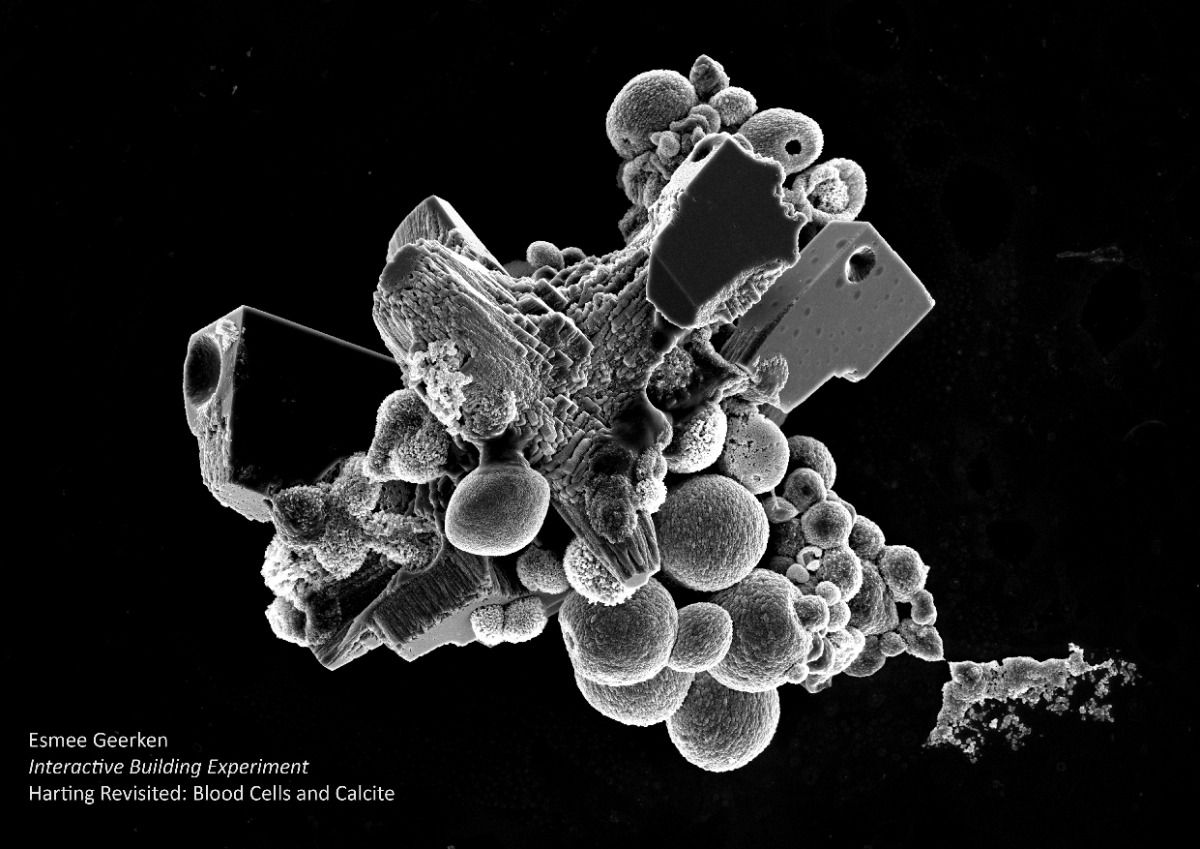
"I like to explore how patterns can arise by itself, without me designing the pattern. To explore this process, I am doing ‘Interactive Building Experiments’ in which I aim to grow new architectural shapes and materials through the interaction of unexpected actors. By bringing together minerals and body fluids in solution, they interact and form new complex shapes. Our current Western way of building is mostly human-centered; we build to serve our human needs. What we have lost sight of is that through the act of building you also influence the environment, resulting in unforeseen outcomes, such as the current climate and ecological crisis. With these building experiments, I would like to investigate how we can renew the balance between interacting with the environment and designing."
Building as Being
The ‘Interactive Building Experiments’ are part of a larger, ongoing project 'Building as Being'. “At the start of the Building as Being project I organized a three-part symposium, together with Waag, and brought together scientists and artist to talk about three different themes. You often notice that scientists walk around with wild ideas and profound experiences, for which there is little room in the usual academic formats. I wanted to give them a platform where they can communicate creative ideas and important experiences with an audience outside of the academic realm. Together, we discussed new urban design strategies from surprising perspectives, such as biology, living matter and sociology. We explored alternatives to the current human-centered way of building, and reflected on how we, as humans, can feel part of the environment again, rather than outsiders. The evenings covered three scales of ‘building’: the City, the Mind, and the Matter. IAS-fellows Brian Castellani and Sharon Wohl were part of these symposiums, as well as previous Artist in Residence Orion Maxted.”
Future
The future holds a lot for Geerken. She is working on a new workshop, together with researchers Bergit Arends and Tom Idema, in which they reflect on what ‘narrating just sustainability in the city’ means and can mean for different communities. Together with artists and scientists they explore the role of narrative and performative actions while facing urgent transitions. Her work of the past year will be showcased at the end of 2022. “The past years I have mainly explored what interactive building can be, inspired by the natural sciences, philosophy, and architecture. The next step for me is to make works of art that people can experience by themselves, enabling them to feel the complexity and feel part of bigger (and smaller) miraculous systems.”