Psychopathology and Plasticity of the Social Brain (hybrid)
UMH Lecture Series
The Centre for Urban Mental Health is organizing a series of online lectures to highlight expertise and current thinking on complexity science and urban mental health. In this session Prof Philipp Kanske will give a lecture on psychopathology and plasticity of the social brain.
Event details from: Psychopathology and Plasticity of the Social Brain (hybrid)
- Date
- 19 April 2023
- Time
- 16:00 – 17:00
The Centre for Urban Mental Health, aims to unravel new pathways to improve urban mental health that takes into account the complexities and dynamics of mental health problems and mental health disorders in an urban environment.
Psychopathology and Plasticity of the Social Brain
The neural networks associated with socio-affective (empathy, compassion) and socio-cognitive processes (mentalizing/Theory of Mind) have been well-characterized over the last years. The goals of the present talk are (1) to explore the separability of these functions during online social understanding on a subjective, behavioral and on a neural level, (2) to investigate the selectivity of impairments in these capacities in psychopathology and (3) to probe the potential for plasticity. To this end, Prof. Kanske will present behavioral and neuroimaging data (fMRI) during a novel social video task participant and a large-scale meta-analysis, behavioral data from clinical populations and comprehensive, longitudinal data from a nine-month training study. His group observed distinct neural networks during empathizing and Theory of Mind. Interestingly, the propensity to share others’ affect and the capacity to mentalize were uncorrelated, both on a behavioral and neural level, suggesting independence. Similarly, his group found selective impairment of empathy, but not Theory of Mind in a group of hyper-aggressive men. Separate training modules focusing on social affect or cognition also had distinct effects on either the reported compassion or Theory of Mind performance and structural markers of the underlying neural networks. The data argue against a general capacity for social cognition, but suggest distinct functions underlying our ability to feel with and understand others, which seems relevant for understanding deficits in social interaction and intervention studies.
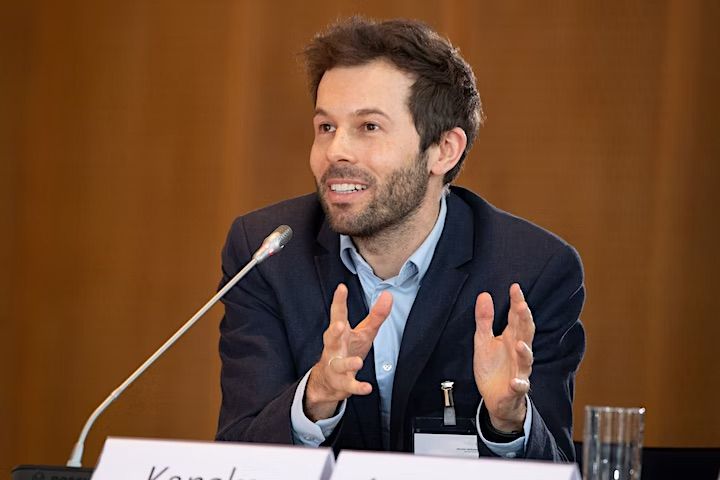
About Prof. Philipp Kanske
Philipp Kanske is Professor for Clinical Psychology and Behavioral Neuroscience, Director of the Institute of Clinical Psychology and Psychotherapy and Co-Director of the Psychotherapy Outpation Clinic at Technische Universität Dresden. His research focuses on the cognitive and affective mechanisms enabling social behavior such as emotion regulation, empathy and perspective-taking. He investigates the alterations of these processes in psychopathology and their plasticity through training and therapy using behavioral and neuroimaging methods. His work has been awarded several research prizes such as the Otto Hahn Medal of the Max Planck Society and the Heinz Maier-Leibnitz Award of the German Research Foundation. 2019/2020, Philipp Kanske was the speaker of the German Young Academy at the National Academy of Sciences Leopoldina. In 2023, he was awared an ERC consolidator grant. For details of his work, please see https://tu-dresden.de/mn/psychologie/klipsy.
Program
16:00 | Presentation |
16:30 | Q&A |
The Q&A session will be based on questions from the audience.
Location
Institute for Advanced Study
Library (2nd floor)
Oude Turfmarkt 147
1012GC Amsterdam
If you do not have access to the IAS building, please email us in advance on assistent.umh@amsterdamumc.nl.
Access:
In-person:
Please email us in advance on assistent.umh@amsterdamumc.nl if you do not have access to the IAS building. The lecture will be held on the second floor, so when you arrive please come straight up (via stairs or elevator).
Online:
Please send an email to assistent.umh@amsterdamumc.nl to receive the Zoom link.